tech
January 28, 2026
My honest field notes on scaling agents past the demo phase + 6 rules from teams running hundreds
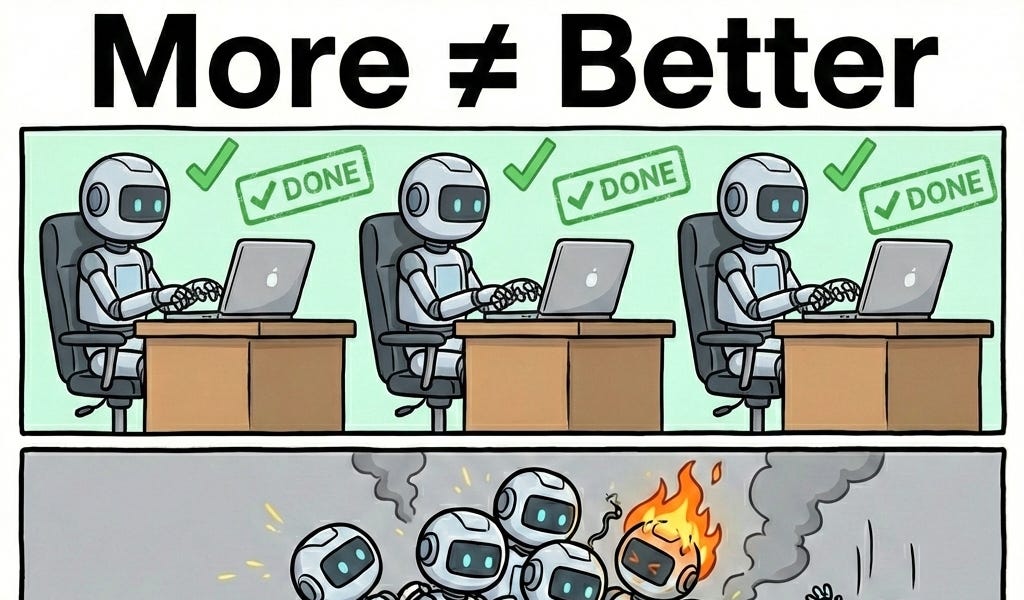
A December 2025 study from Google and MIT found something I wasn’t expecting: adding more agents to a system can make it perform worse. Not diminishing returns—actual degradation. The researchers documented configurations where more agents produced worse outcomes than fewer—a finding that directly challenges the field’s working assumption that adding agents means adding capability.
TL;DR
- A Google and MIT study found that adding more agents to a system can degrade its performance, contradicting the assumption of adding capability.
- Coordination overhead increases with more agents, leading to inefficiency and a "standing in line" effect.
- Teams like Cursor and Steve Yegge's Gas Town have independently converged on simple, counterintuitive architectural patterns for scaling multi-agent systems.
- The research highlights the scaling problem caused by coordination overhead and presents six rules from teams running hundreds of agents.
- It argues for 'dumb agents' and 'smart orchestration,' suggesting that this inversion is crucial for system performance.
- Gartner predicts over 40% of agentic AI projects will be canceled by the end of 2027, indicating many projects haven't addressed these scaling issues.