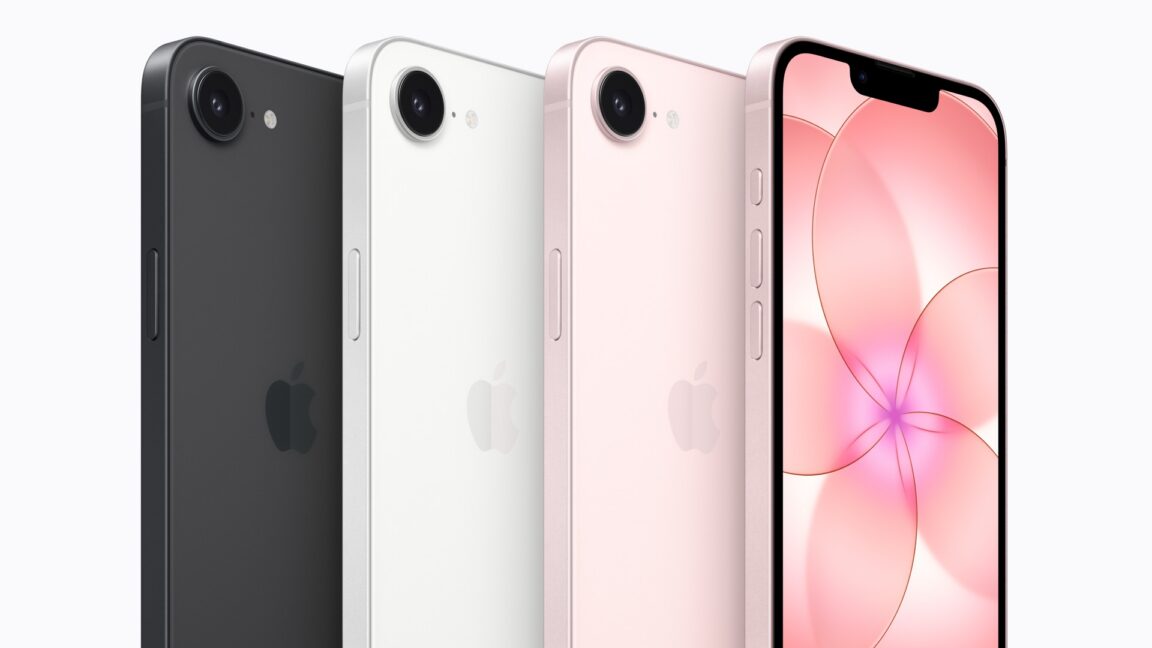
Apple and non-Apple coverage, whether generated by AI or written by human reporters, consistently describe the iPhone 17e as a new entry-level or budget-friendly iPhone priced at about $599, positioned at the lower end of Apple’s lineup but with relatively premium specifications. Both perspectives agree that the device uses Apple’s latest A19 chip, comes standard with 256 GB of storage, supports Apple Intelligence features, offers MagSafe and Qi2 wireless charging up to 15W, includes a 48‑megapixel main camera with advanced portrait capabilities, and retains durability features such as an IP68 rating and Ceramic Shield 2 on a roughly 6.1‑inch display. They also align on launch timing, describing preorders opening in early March (around March 4) and general availability following shortly after (around March 11), as well as on the presence of a faster next‑generation cellular modem and other incremental hardware refinements.
Both AI and human coverage place the iPhone 17e within Apple’s broader strategy of pushing advanced chips and on‑device AI features down into more affordable tiers, while keeping overall design and ecosystem integration familiar. They frame the A19 chip and Apple Intelligence support as part of Apple’s long trajectory toward tightly integrating hardware, software, and custom silicon to differentiate from Android competitors, especially around privacy‑preserving, on‑device machine learning. Both perspectives acknowledge that the 17e continues Apple’s pattern of using durable materials, standardizing on features like MagSafe, and locking users into complementary services and accessories, portraying this model as a bridge between high‑end flagship capabilities and mass‑market price sensitivity.
Areas of disagreement
Product positioning and emphasis. AI‑aligned coverage tends to emphasize where the iPhone 17e sits in Apple’s overall portfolio, comparing it numerically to past models and speculating about how it may impact sales of higher‑end iPhones, while human outlets more often stress its identity as a budget‑friendly or entry‑level device for people who skipped recent upgrade cycles. AI sources are more likely to highlight benchmark‑style performance claims and theoretical AI workloads enabled by the A19 chip, whereas human coverage foregrounds practical selling points like the $599 price, doubled base storage, and camera improvements. As a result, AI narratives skew toward a product‑line optimization story, while human reporting frames it as a value proposition for typical buyers.
AI features and privacy framing. AI coverage generally spotlights Apple Intelligence as the headline feature, describing detailed use cases, edge inference capabilities, and architectural changes in the A19 chip that enable more on‑device processing, sometimes extrapolating beyond Apple’s explicit statements. Human reporting, by contrast, tends to mention Apple Intelligence more briefly as a box‑checked feature, focusing instead on tangible upgrades like MagSafe with Qi2, modem speed, and camera quality rather than deep dives into AI internals. When privacy is mentioned, AI‑aligned sources are more inclined to present Apple’s technical privacy claims and comparisons with rival ecosystems, whereas human outlets either compress this into a short reassurance or omit it in favor of more immediate, lifestyle‑oriented angles.
Consumer impact and upgrade logic. AI sources often approach the iPhone 17e through a decision‑tree lens, modeling which prior iPhone owners should upgrade based on performance curves, AI feature access, and long‑term software support windows, sometimes suggesting that the A19 and Apple Intelligence support make this the new baseline for future‑proofing. Human outlets, however, tend to explain the upgrade logic more narratively, describing the phone as appealing to users with older devices who want better photos, more storage, and longer battery life without paying flagship prices. This leads AI coverage to sound more like optimization advice for tech‑savvy readers, while human coverage centers on everyday trade‑offs and the emotional calculus of value and longevity.
Competitive and market analysis. AI‑aligned reporting is more likely to embed the 17e in quantitative market context, speculating on unit mix, gross margins, and its role in Apple’s strategy to defend midrange share against Android rivals, often referencing prior sales data or forecast models. Human coverage instead tends to reference the competitive landscape more anecdotally, mentioning rival devices or "Android midrange" phones mainly to give readers a sense of alternatives without heavy analytics. Consequently, AI narratives lean toward macro‑strategy and financial implications, whereas human pieces are more focused on what the phone feels like as a purchase in a crowded smartphone market.
In summary, AI coverage tends to frame the iPhone 17e as a node in Apple’s long‑term technical and market strategy with emphasis on AI architecture, benchmarks, and portfolio optimization, while Human coverage tends to frame it as a concrete upgrade choice for everyday buyers, emphasizing price, camera, storage, and practical day‑to‑day benefits.
Story coverage