Human
We have a jury.
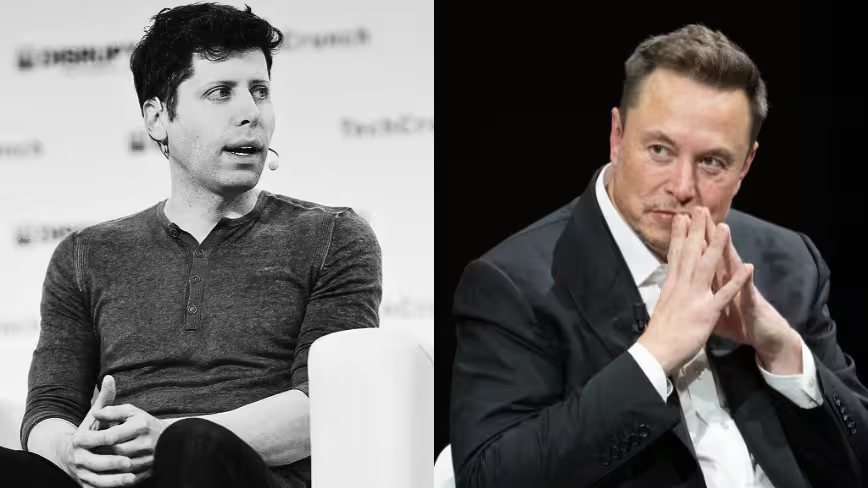
Elon Musk and Sam Altman’s court battle over the future of OpenAI
2 days ago
The long‑simmering feud between Elon Musk and Sam Altman has moved from boardrooms and social media into a federal courtroom in Northern California, where a jury is now empaneled to weigh not just old grievances but the future governance of one of the world’s most influential AI labs.
In 2015, Musk, Altman, Greg Brockman and others launched OpenAI as a nonprofit research lab, publicly framed as an altruistic counterweight to Big Tech’s AI ambitions. Musk now argues that there was an “explicit understanding” OpenAI would remain a nonprofit dedicated to developing artificial general intelligence (AGI) for the benefit of humanity, and that his early funding—about $38 million—was given on that basis.12
OpenAI’s structure began to change in 2019, a year after Musk left its board, when it created a capped‑profit subsidiary to attract the billions in capital needed to train ever‑larger models and struck a landmark partnership with Microsoft. Musk contends this amounted to a betrayal: the nonprofit he helped to found had turned into what he characterizes as a de‑facto for‑profit, closely tied to a tech giant he once hoped OpenAI would counterbalance.23
OpenAI rejects that narrative. The company says Altman and Brockman did not deceive Musk, and that internal records show he was actively involved in the very discussions that led to the for‑profit structure. According to OpenAI’s account, Musk pushed for far greater control, including merging OpenAI into Tesla and installing himself as leader of the combined entity; when colleagues resisted, he chose to walk away and later founded his own AI lab, xAI.3
A 2017 diary entry by Brockman has become one of the most contentious pieces of evidence. In it, he reportedly wrote: “This is the only chance we have to get out from Elon. Is he the ‘glorious leader’ that I would pick?”3 Musk casts this as proof of a deliberate effort to edge him out and reorient the organization. OpenAI is expected to argue it shows internal concern over governance style, not a scheme to defraud a donor.
By early 2023, Musk had begun attacking OpenAI and Altman more aggressively in public, accusing them of drifting from the lab’s original mission. Business Insider reports that Altman privately texted Musk at the time to say he was “tremendously thankful” for Musk’s early help and that it “really … hurts” to see him publicly attacking OpenAI.2
In 2024, Musk turned those criticisms into a sweeping federal lawsuit in the Northern District of California, targeting OpenAI, Altman, Brockman and Microsoft. The complaint alleges breach of charitable trust and fraud, and asserts Microsoft “aided and abetted” the supposed betrayal of the nonprofit mission. Musk is seeking up to $150 billion in damages, which he says should be directed to OpenAI’s charitable arm, along with the removal of Altman and Brockman from leadership and a court order forcing OpenAI to revert to a pure nonprofit.34
Musk’s side frames the case starkly. OpenAI, he says, abandoned “its founding mission of developing AI to benefit humanity” and instead shifted to “boosting profits.”4 In the words of one sympathetic commentator Musk amplified on X, OpenAI “pretend[ed] to a non‑profit mission to save humanity until it pocketed his donations. Elon should win.”5
Musk has personally adopted the label “Scam Altman,” posting the phrase publicly on X as the dispute escalated.6 In another brief message—“Long list” attached to an investigation framing Altman as a serial “con artist”—he signaled support for critics who argue Altman has left a trail of disillusioned allies. 7 The social‑media volleys underscore how much of this conflict has already been tried in the court of public opinion before reaching an actual jury.
OpenAI and its allies paint a very different picture of both the past and Musk’s motives. In court filings and public statements, the company has described the lawsuit as “a baseless and jealous bid to derail a competitor,” arguing that Musk is upset his own AI venture, xAI, “lags so far behind” OpenAI’s ChatGPT and related products.42
OpenAI maintains that it “remains a nonprofit — albeit with a for‑profit subsidiary,” and that the capped‑profit structure was transparently adopted to fund the immense compute and talent costs of state‑of‑the‑art AI research.2 Far from a bait‑and‑switch, they say, this was the only viable way to scale the organization while keeping a mission‑focused board in ultimate control.
Supporters of Altman and OpenAI also push back on Musk’s personal attacks. While Musk amplifies posts calling Altman a scammer, other commentators emphasize Altman’s leadership in rapidly commercializing AI and integrating safety research into product development; those views are likely to surface more during trial testimony than in pre‑trial filings.
Media coverage has cast the looming courtroom clash in dramatic terms. One outlet described the case as a “showdown”; another dubbed it a “battle for OpenAI’s soul,” emphasizing that jurors will be asked whether “flawed human beings can be trusted to run unimaginably powerful companies.”2
Financially, the numbers are huge. One Business Insider analysis pegs this as a $134 billion federal civil trial, reflecting OpenAI’s sky‑high valuation and the potential impact of a ruling on its corporate structure.1 Another outlet notes Musk is asking for $150 billion in damages and structural remedies that could reverberate across the AI industry and nonprofit law: forcing one of the world’s most valuable AI developers to unwind its for‑profit arm would be unprecedented.34
The case has drawn in some of the most powerful figures in tech. Witness lists include Microsoft CEO Satya Nadella, OpenAI executives Mira Murati and Ilya Sutskever, early Musk associate Shivon Zilis, OpenAI cofounder Greg Brockman, and Musk’s long‑time financial lieutenant Jared Birchall, among others.1 Judge Yvonne Gonzalez Rogers, known for her handling of high‑profile tech cases, will preside, with Musk expected to spend at least six hours testifying and Altman similarly taking the stand for extended questioning.1
On Monday, April 27, the years‑long legal and rhetorical battle “moved from social media to a federal courtroom in Oakland, California,” as jury selection began in the US District Court for the Northern District of California.3 A reporter in the room noted simply: “The Elon Musk vs. OpenAI trial starts today. I’m in the courtroom — and jury selection will begin shortly. Sam Altman is here, but I haven’t seen Elon Musk.”4
The proceeding is scheduled as a four‑week federal trial running through mid‑May, Monday through Thursday. While a jury will hear the case, its verdict will be advisory: the ultimate decision on liability and remedies rests with Judge Gonzalez Rogers, who accelerated the core claims to trial, citing the strong public interest in a swift resolution.3
Inside the courtroom, voir dire revealed the cultural baggage both sides must navigate. According to on‑the‑ground reporting, Musk’s lawyers tried to strike jurors who openly disliked Musk, but Judge Gonzalez Rogers refused to exclude them for that reason alone. “The reality is that people don’t like him,” she said. “Many people don’t like him, but that doesn’t mean that Americans nevertheless can’t have integrity for the judicial process.”4
Prospective jurors reported varied experience with AI tools, from routine users of chatbots to those deeply skeptical of the technology’s social impact. Outside the courthouse, reporters noted “Happenings” and that “things are exciting outside,” reflecting the circus‑like atmosphere that often accompanies trials involving tech billionaires and transformative technologies.46
By late in the day, one Verge update captured a milestone: “We have a jury. Opening statements tomorrow.”5 With nine jurors selected, the case formally shifted from selecting who will judge the evidence to presenting that evidence.
When opening statements begin, Musk’s team is expected to lean heavily on the founding narrative and documents like Brockman’s diary entry to argue that OpenAI pulled a “bait‑and‑switch” on both Musk and the public: soliciting donations and goodwill as a nonprofit “for humanity,” then embracing closed, profit‑driven development tied to Microsoft.35
OpenAI’s lawyers, by contrast, will likely trace the group’s early debates over scale and control to show that Musk was a sophisticated insider who understood and at times championed the pivot to a hybrid model. They will portray the Microsoft partnership as a pragmatic necessity, not a sellout, and emphasize that the nonprofit board still holds ultimate power over the for‑profit arm.3
Musk’s own social‑media posts could cut both ways. On one hand, his retweets praising his “monumental” influence on OpenAI—“there simply wouldn’t have been the AI world we have today,” one supporter wrote—underscore his central role as a funder and early visionary.8 On the other, OpenAI may argue that his ongoing “Scam Altman” attacks and amplifying of hostile commentary reveal competitive animus more than altruistic concern.67
Musk’s allies insist his motives are principled. In a tweet he boosted, one supporter urged people not to treat the dispute like a mere “billionaire feud,” arguing that Musk does not spend his wealth on yachts or islands and suggesting “even the money from this lawsuit, if he wins,” would not go to personal extravagance.9 That framing dovetails with Musk’s request that any damages be routed to OpenAI’s nonprofit mission rather than to him personally.3
Whatever Judge Gonzalez Rogers ultimately decides, the trial is poised to set important precedents. It will test how US courts treat disputes over mission drift in hybrid nonprofit/for‑profit structures and may influence how other AI labs structure their governance, particularly when partnering with deep‑pocketed tech giants.
For now, the world’s leading AI startup—and one of its most vocal critics—are locked in a courtroom drama that pits competing visions of altruism, ambition, and control against each other. As one tech outlet summarized, this is more than a personality clash; it is “Elon Musk and Sam Altman’s court battle over the future of OpenAI.”4