

Human
OpenAI breaks free of Microsoft's cloud
With its newest partnership deal OpenAI gets the cloud freedom Anthropic always had.
2 days ago
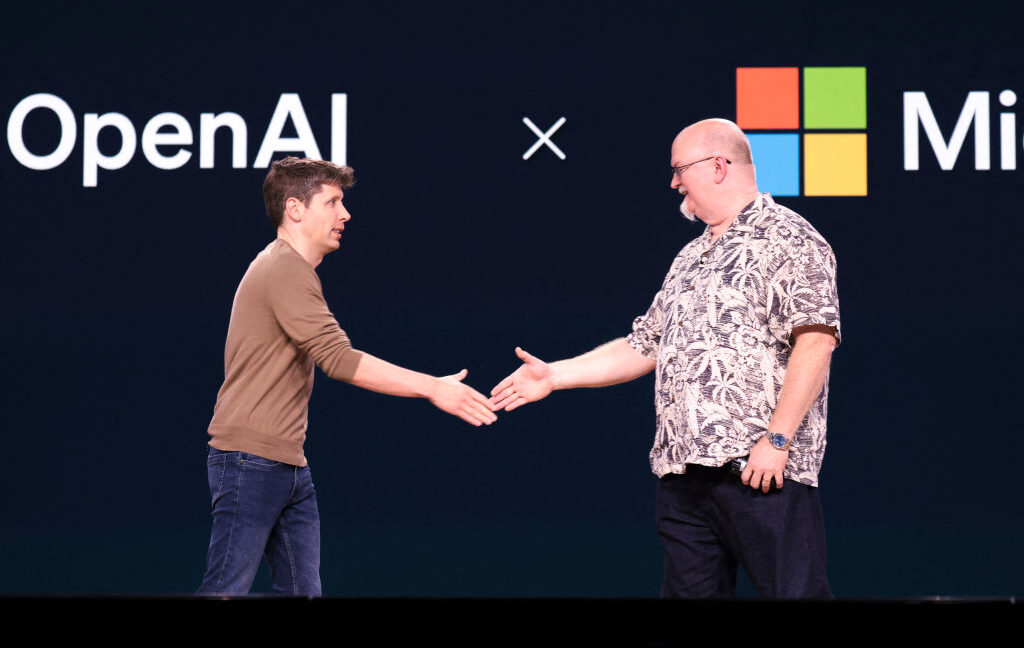
Microsoft and OpenAI have redrawn the contours of one of tech’s most consequential alliances, trading deep exclusivity and an AGI‑triggered future for time‑boxed IP rights, multi‑cloud freedom, and clearer—if more transactional—business terms.
Microsoft’s bet on OpenAI began in 2019 with a $1 billion investment and a tightly coupled, Azure‑first relationship that quickly became “one of the strongest and most consequential” partnerships in the AI industry.1 Under that structure, Microsoft secured broad, largely exclusive access to OpenAI’s models and intellectual property, and OpenAI in turn relied heavily on Azure for the massive compute needed to train and serve frontier systems.
A distinctive feature of the original arrangement was an “AGI clause” that tied the long‑term economics and IP rights to the moment OpenAI was deemed to have achieved artificial general intelligence—loosely, systems matching or surpassing human capabilities across a wide range of tasks.2 If an expert panel agreed OpenAI had reached AGI, elements of the revenue‑sharing and exclusivity would change.
The first big shock to this structure came in October 2025, when OpenAI completed a controversial corporate restructuring into a capped‑profit entity and renegotiated its agreement with Microsoft. That round already softened parts of the exclusivity and adjusted the AGI clause, but left in place the idea that OpenAI’s technological progress—especially toward AGI—would determine the partnership’s endgame.2
By then, OpenAI had also committed to enormous Azure spending. In October, it agreed to buy an additional $250 billion worth of Microsoft cloud capacity, a signal to investors that, despite any governance drama, OpenAI would remain a massive Azure customer for years.3
The fragile balance was upended in February 2026, when OpenAI announced a deal with Amazon worth up to $50 billion. The arrangement combined a $15 billion initial investment with a further $35 billion “in the coming months when certain conditions are met,” and included plans to co‑develop a “stateful runtime technology” on AWS Bedrock, Amazon’s managed AI model platform.3
This clashed with the still‑in‑force Microsoft terms. Microsoft had believed it held exclusive rights to serve OpenAI models in the cloud, and the Financial Times reported that Microsoft was considering legal action to block the AWS deal.4 Internally, OpenAI leaders also acknowledged that Microsoft’s exclusivity was becoming a commercial constraint. In a memo obtained by CNBC, OpenAI chief revenue officer Denise Dresser wrote that the partnership had “limited our ability to meet enterprises where they are — for many that’s [Amazon] Bedrock,” adding that interest in running OpenAI models on Amazon’s cloud had “been frankly staggering.”1
On April 26, OpenAI and Microsoft publicly unveiled a newly amended agreement. The companies framed it as a modernization suited to the “rapid pace of innovation,” saying the update was “grounded in flexibility, certainty, and a focus on delivering the benefits of AI broadly.”5
In a joint outline of the new terms, they highlighted five key changes:5
Cloud priority, not exclusivity
Microsoft “remains OpenAI’s primary cloud partner,” and “OpenAI products will ship first on Azure, unless Microsoft cannot and chooses not to support the necessary capabilities.” But OpenAI “can now serve all its products to customers across any cloud provider.”
Non‑exclusive IP license through 2032
Microsoft keeps a license to OpenAI IP for models and products through 2032, but that license “will now be non‑exclusive,” allowing OpenAI to make the same or similar models available via other partners.
Microsoft stops paying revenue share to OpenAI
Under prior arrangements, Microsoft shared some Azure revenue back to OpenAI; that share is now eliminated.
OpenAI’s payments to Microsoft are capped and time‑limited
Revenue‑share payments from OpenAI to Microsoft will “continue through 2030, independent of OpenAI’s technology progress, at the same percentage but subject to a total cap.”
Microsoft remains a major shareholder
Microsoft “continues to participate directly in OpenAI’s growth as a major shareholder,” preserving its equity upside.5
OpenAI CEO Sam Altman echoed the new flexibility on X, writing that Microsoft will stay the “primary cloud partner,” but that OpenAI is “now able to make our products and services available across all clouds,” while continuing to provide Microsoft “models and products until 2032, and a revenue share through 2030.” 6
6
As details filtered out through the tech press on April 27, a central theme emerged: the new deal is less exclusive and the AGI trigger is gone.
The Verge reported that “Microsoft and OpenAI’s partnership‑turned‑situationship just got even less committed,” noting that the long‑standing “AGI clause … has officially been dropped.”2 Under the old design, revenue‑share payments from OpenAI to Microsoft were meant to continue until AGI was declared. Now, those payments “will only continue through 2030” and will end “independent of OpenAI’s technology progress” and “subject to a total cap,” leading the outlet to declare: “So RIP to that deal.”2
Business Insider stressed that this was the second renegotiation in six months, following the October 2025 restructuring. It summarized the change in posture: Microsoft “will remain OpenAI’s primary cloud partner and OpenAI will ship its products on Azure first,” but if Microsoft “cannot and chooses not to support the necessary capabilities,” OpenAI “can work with any other cloud partner,” and is “now able to serve its products to customers across any cloud provider.”4 Microsoft’s license to OpenAI products through 2032 is now non‑exclusive, revenue‑share payments from Microsoft to OpenAI are eliminated, and OpenAI’s payments to Microsoft are capped and decoupled from an AGI declaration.4
From a legal and deal‑making standpoint, TechCrunch argued that “both sides are walking away winners.” The new non‑exclusive IP license through 2032 replaces earlier expectations that Microsoft would have exclusive access “until the magical day when OpenAI produces AGI,” and crucially, it “solves the possibility that Microsoft could sue OpenAI over the AI lab’s deal with Amazon.”3 OpenAI products must still ship “first on Azure,” but “OpenAI can now serve all its products to customers across any cloud provider.”3
Ars Technica framed the move in more symbolic terms, declaring that “OpenAI ends its exclusive partnership with Microsoft.” The outlet noted that Microsoft’s license “will now be non‑exclusive,” letting OpenAI place its models on other major clouds, and that the revenue share OpenAI pays—still pegged at 20 percent—is “now limited to an unspecified cap” and “independent of OpenAI’s technology progress,” an “apparent reference to the infamous ‘AGI clause’” that once anchored the deal’s future.1
Market analysts also welcomed the clarity. Wedbush described the changes as a “net positive for Microsoft,” which “locks in a 6‑year IP control over OpenAI technology and maintains a significant share of OpenAI while ending the back‑and‑forth between Redmond and OpenAI.”4
The amended terms almost immediately unlocked moves by competitors. Ars Technica reported that the change “clears the way for OpenAI models to run on Amazon Bedrock.”1 Axios said Amazon and OpenAI were “poised to quickly capitalize,” quoting Amazon CEO Andy Jassy, who wrote on X: “We’re excited to make OpenAI’s models available directly to customers on Bedrock in the coming weeks,” with more details promised at an AWS event in San Francisco.7
Axios described the broader impact: the rewritten pact “lets [OpenAI] sell AI models across multiple clouds, enabling a likely expansion with Amazon and broader enterprise distribution,” ending “OpenAI’s effective cloud exclusivity” and “intensifying AI platform competition.”7 Microsoft, meanwhile, no longer has to share Azure revenue with OpenAI, but continues to receive 20 percent of OpenAI revenue until 2030, now subject to a cap.7
In their joint narrative, the two companies are emphasizing stability and scale. The amended agreement “strengthens our joint ability to build and operate AI platforms at scale while providing both companies the flexibility to pursue new opportunities,” they wrote.5 They also underscored ongoing collaboration “from scaling gigawatts of new datacenter capacity, to collaborating on next‑generation silicon, to applying AI to advance cybersecurity.”5
OpenAI’s leadership casts the change as necessary to meet customers where they already are—often on AWS or Google Cloud—without abandoning Azure as the primary partner. Altman’s public message focused on continuity (staying with Microsoft as primary cloud) and expansion (serving “products and services … across all clouds”) rather than on the demise of the AGI clause or legal tensions.6
Outside the two companies, the decision to remove the AGI‑linked trigger has stirred concern among those focused on OpenAI’s original charitable mission.
On X, Elon Musk amplified criticism that “OpenAI just REMOVED the AGI clause that was a structural protection of OpenAI’s charitable mission,” highlighting a thread that argued the 2019 capped‑profit structure had several mission‑aligned protections that have since been dismantled. 8 For these critics, decoupling financial terms from AGI progress marks another step away from OpenAI’s founding promise to prioritize broad societal benefit over shareholder returns.
Across financial and industry analysis, the overarching interpretation is that this renegotiation normalizes a partnership that had become unusually dependent on a speculative milestone—AGI—whose definition is “hotly debated.”4 By replacing open‑ended, AGI‑driven obligations with fixed dates (2030 for revenue sharing, 2032 for IP rights) and non‑exclusive licensing, Microsoft and OpenAI move closer to standard large‑scale commercial arrangements.
For OpenAI, the shift opens immediate revenue opportunities via AWS, Google Cloud, and other providers, even as it remains contractually bound to ship first on Azure.3 For Microsoft, it locks in years of access to OpenAI technology and revenue participation, while removing the need to litigate over the Amazon tie‑up and to guess when—or whether—AGI might be declared.
Chronologically, the Microsoft–OpenAI relationship has moved from exclusive, AGI‑anchored alliance (2019) to restructured, still‑tight partnership (October 2025), to a more open, multi‑cloud, time‑bounded deal (April 2026). Substantively, two shifts stand out:
As OpenAI and Amazon move to operationalize their $50 billion partnership under the new terms, and as Microsoft continues scaling infrastructure and integrating OpenAI models into its own products, the revised pact sets the stage for a more openly competitive era in cloud‑based AI—one in which the same frontier models may soon be available, in different forms, across all of the major platforms.