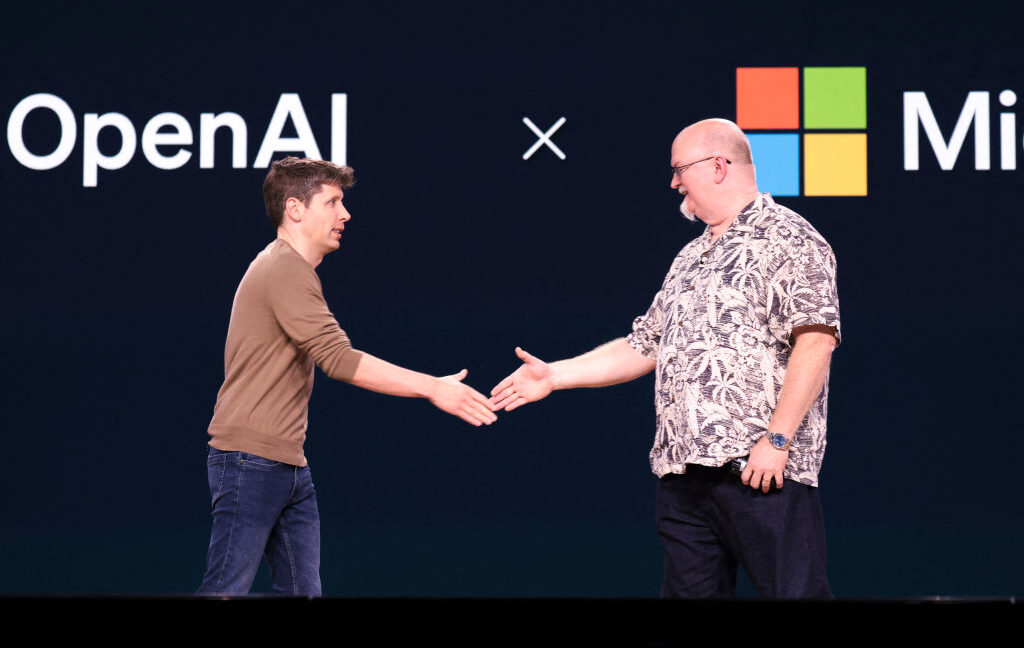
Microsoft and OpenAI just re‑wrote the rules of their AI marriage, trading cloud exclusivity and a grand “AGI pact” for something more pragmatic: a long‑term, open‑relationship business deal.
From star‑crossed partners to serial renegotiators
The Microsoft–OpenAI alliance has been the gravitational center of the AI industry since Redmond’s first $1 billion bet in 2019, built around exclusive access to OpenAI models on Azure and a baroque clause about what would happen if OpenAI ever hit artificial general intelligence.
By late 2025, the relationship was already under strain. In October, after OpenAI completed a controversial corporate restructuring into a for‑profit entity, the two sides quietly rewrote their agreement for the first time, reshaping how profits and AGI would be handled.
Six months later, they were back at the table.
On April 26, 2026, the companies jointly announced “the next phase” of their partnership, saying they needed to “evolve” the deal to match “the rapid pace of innovation” and to give both sides “flexibility” and “greater predictability” in how they operate AI platforms at scale.
April 2026: The new deal lands
The amended agreement, outlined by OpenAI and Microsoft in their joint statement, does four big things at once:
Cloud: from exclusive to open, with Azure still first in line.
Microsoft “remains OpenAI’s primary cloud partner,” and OpenAI products will still “ship first on Azure, unless Microsoft cannot and chooses not to support the necessary capabilities.”
Crucially, OpenAI “can now serve all its products to customers across any cloud provider.”
Licensing: Microsoft’s grip loosens but doesn’t disappear.
Microsoft keeps “a license to OpenAI IP for models and products through 2032,” but that license is now “non‑exclusive,” freeing OpenAI to license its tech more broadly.
Money: revenue flows only one way, for a limited time.
Microsoft will “no longer pay a revenue share to OpenAI.”
Revenue‑share payments from OpenAI to Microsoft continue “through 2030, independent of OpenAI’s technology progress … at the same percentage but subject to a total cap.”
Equity: the stake stays.
Microsoft “continues to participate directly in OpenAI’s growth as a major shareholder.”
By April 27, coverage framed this bluntly: “OpenAI and Microsoft renegotiated their deal for the second time in 6 months. See what's new.” The once‑iconic exclusivity is gone.
The Amazon shock and Microsoft’s legal headache
This wasn’t just abstract contract cleanup. The new terms are a direct answer to a looming fight over Amazon.
In February, OpenAI announced a mammoth, “up‑to‑$50 billion dollar deal with Amazon,” including a $15 billion initial investment and another $35 billion to follow if certain conditions were met. In exchange, OpenAI agreed to co‑develop “stateful runtime technology” on AWS Bedrock — Amazon’s managed AI platform — and to make certain models available there.
That collided head‑on with Microsoft’s view of its exclusivity. Microsoft “viewed” the OpenAI–AWS agreement “as potentially being violated” by their original partnership, and was “considering legal action to stop the $50 billion deal,” the Financial Times reported and Business Insider relayed.
The April amendment largely dissolves that threat. As TechCrunch put it: “the new terms solve an issue that was hanging over OpenAI’s head since it signed its up‑to-$50 billion dollar deal with Amazon.” Instead of Microsoft having “exclusive access to all of OpenAI’s products and IP until the magical day when OpenAI produces AGI,” there is now a definitive, dated structure: a non‑exclusive license through 2032, and revenue share to 2030.
Ars Technica notes the immediate practical consequence: OpenAI can “serve all its products to customers across any cloud provider,” clearing the way for OpenAI models to “run on Amazon Web Services” and other platforms.
Internally, OpenAI executives had been blunt about why this had to happen. In a memo obtained by CNBC, chief revenue officer Denise Dresser told staff the Microsoft partnership had “limited our ability to meet enterprises where they are — for many that’s [Amazon] Bedrock,” adding that interest in running OpenAI models through Amazon’s cloud had “been frankly staggering.”
No wonder Amazon CEO Andy Jassy was, in Ars’s words, “excited to make OpenAI’s models available directly to customers on Bedrock in the coming weeks.”
Killing the AGI clause: mission vs money
If the Amazon fallout forced the timetable, the most symbolic casualty of the renegotiation is the so‑called AGI clause.
For years, the Microsoft–OpenAI deal had a science‑fiction core: if an expert panel agreed OpenAI had achieved “artificial general intelligence” — loosely, systems that “equal or surpass human intelligence on a wide range of tasks” — then revenue‑sharing and exclusivity would snap to a different regime.
That clause is now dead. “Microsoft and OpenAI’s Famed AGI Agreement Is Dead,” declared The Verge. The new revenue‑share language is explicit: payments from OpenAI to Microsoft run through 2030 and end, “independent of OpenAI’s technology progress,” removing AGI from the financial equation.
That shift has ignited a second, more existential fight — over OpenAI’s original mission.
Elon Musk amplified one such critique while this latest deal dropped, retweeting: “🚨 OpenAI just REMOVED the AGI clause that was a structural protection of OpenAI's charitable mission, while jury selection was happening today.” The underlying thread warned that key safeguards of the 2019 structure were being stripped away in favor of unconstrained profit.
From this perspective, killing the AGI clause is not a boring legal cleanup; it’s the final severing of OpenAI’s self‑imposed leash.
How each side is spinning it
OpenAI: freedom to sell everywhere
OpenAI’s public line is simple: this is about flexibility and scale. The company’s blog stresses that the amended agreement is “grounded in flexibility, certainty, and a focus on delivering the benefits of AI broadly,” and that the predictable, capped payments “strengthen” both firms’ ability to “build and operate AI platforms at scale” while each pursues “new opportunities.”
Altman’s post on X leans into the newly open cloud strategy — “able to make our products and services available across all clouds” — while reassuring Microsoft that it stays the “primary cloud partner” and keeps a revenue channel to 2030.
Microsoft: lock in the upside, lose the drama
On Wall Street, the mood is more pragmatic than romantic. Business Insider, citing a Wedbush analysis, said investors see the end of “ongoing partnership limbo” as “a net positive for Microsoft,” which “locks in a 6-year IP control over OpenAI technology and maintains a significant share of OpenAI while ending the back-and-forth between Redmond and OpenAI and setting the stage for Microsoft to get all revenue generation on its core platform.”
In other words: fewer legal migraines, still plenty of AI upside, and a clearer story for shareholders.
TechCrunch underlines that “both sides are walking away winners,” arguing that while some on X framed this as OpenAI finally breaking free, Microsoft still gets a preferred position as “primary cloud partner” and a massive committed customer — including a prior pledge from OpenAI to buy $250 billion of Azure capacity — even as OpenAI “rushes to build its own data centers with other partners.”
Competitors and customers: game on
For Amazon and other clouds, the change is a green light. Ars notes that making Microsoft’s license “non-exclusive” lets OpenAI “make its models available through other major cloud providers going forward.” Enterprise buyers who were locked into Azure to access frontier OpenAI models can now push their existing providers — AWS, Google Cloud, or others — to bring those models to where their data and workloads already live.
That’s not just a distribution tweak; it’s a competitive earthquake in the AI infrastructure market.
The big picture: a less romantic, more normal AI world
Chronologically, this looks like a classic tech‑industry arc:
2019–2023: Microsoft buys a privileged front‑row seat to the hottest AI lab in town, with exclusivity, AGI fantasies, and mission language baked in.
October 2025: OpenAI’s for‑profit restructuring forces a first rewrite of the pact, watering down some of the original safeguards and resetting terms around AGI.
February 2026: OpenAI signs an up‑to‑$50 billion deal with Amazon, triggering Microsoft’s lawyers and exposing how brittle “exclusive” had become.
April 26–27, 2026: The second renegotiation in six months: exclusivity is scrapped, the AGI clause is buried, Microsoft’s license becomes non‑exclusive to 2032, and money flows one‑way from OpenAI to Microsoft until 2030 on a capped basis.
Strip away the rhetoric and the new arrangement looks less like a moon‑shot pact to steward humanity into the AGI era and more like what it actually is: a high‑stakes, multi‑cloud commercial platform deal between a hyperscaler and its star supplier.
Whether that makes the world safer or more precarious depends on which perspective you buy. To OpenAI and Microsoft, this is mature governance: flexibility, predictability, and clean incentives. To critics like Musk and the mission‑focused faction, it’s another sign that OpenAI has fully crossed the river from nonprofit guardian to profit‑maximizing AI juggernaut.
Either way, the message to the rest of the industry is unmistakable: the AGI romance is over. The cloud wars are back on.
1. The next phase of the Microsoft OpenAI partnership — "Today, we are announcing an amended agreement to simplify our partnership ... Microsoft remains OpenAI’s primary cloud partner ... OpenAI can now serve all its products to customers across any cloud provider. Microsoft will no longer pay a revenue share ... Revenue share payments from OpenAI to Microsoft continue through 2030 ... subject to a total cap."
2. @sama on X — "we have updated our partnership with microsoft. microsoft will remain our primary cloud partner, but we are now able to make our products and services available across all clouds. will continue to provide them with models and products until 2032, and a revenue share through 2030."
4. OpenAI ends Microsoft legal peril over its $50B Amazon deal — The new contract “solves the possibility that Microsoft could sue OpenAI” over an up‑to‑$50 billion AWS deal and replaces open‑ended AGI‑based exclusivity with a non‑exclusive IP license to 2032.
5. OpenAI ends its exclusive partnership with Microsoft — The amended agreement lets OpenAI “serve all its products to customers across any cloud provider” and makes Microsoft’s license non‑exclusive, clearing the way for OpenAI models on Amazon Bedrock, which Amazon’s CEO said he was “excited” to offer.
6. Microsoft and OpenAI’s Famed AGI Agreement Is Dead — The companies killed the “AGI clause,” which had tied revenue‑sharing to a declaration of artificial general intelligence, replacing it with capped payments through 2030 “independent of OpenAI’s technology progress.”
7. @elonmusk on X — Retweeting: "🚨 OpenAI just REMOVED the AGI clause that was a structural protection of OpenAI's charitable mission ... The 2019 capped-profit structure had three protections for the charitable mission ..."