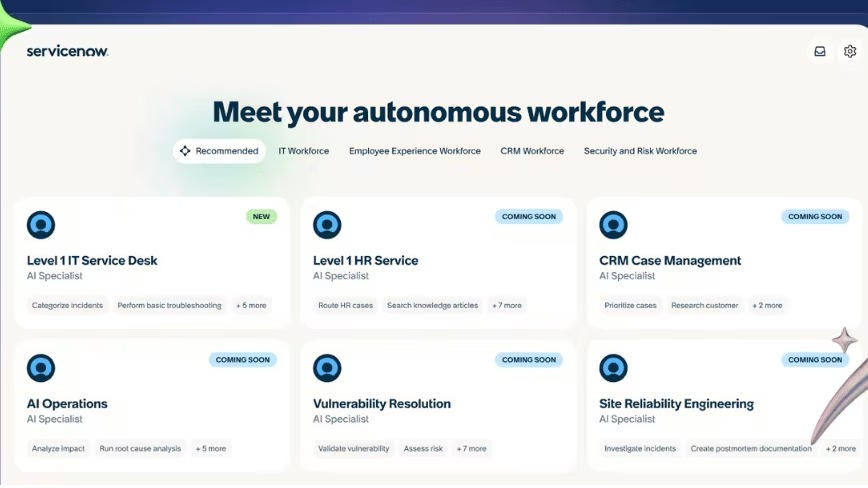
ServiceNow is betting its future on AI — and putting a $30 billion price tag on that conviction by 2030. The company isn’t just trying to survive the AI wave; it’s telling Wall Street it intends to surf on top of it.
2025–2026: From AI threat to AI thesis
For the last two years, ServiceNow has been cast as a test case for a brutal question hanging over enterprise software: do generative AI agents make expensive workflow platforms obsolete, or more valuable?
By early 2026, investors weren’t sure. Even a strong first quarter — 22% year-over-year growth in subscription revenue to $3.67 billion — didn’t stop the stock from sliding on fears that AI might compress margins, stall deals, or push customers toward rolling their own tools with foundation models.
Internally, though, ServiceNow was sharpening a counter-narrative: AI wasn’t a margin-killer or a displacement risk. It was the growth engine.
The company’s flagship AI suite, Now Assist, quietly crossed $600 million in annual contract value (ACV) in 2025 and reached more than $750 million by the first quarter of 2026. That traction set the stage for a more aggressive story.
May 4, 2026: Investor Day and the $30 billion line in the sand
On May 4, 2026, ServiceNow used its investor day to go loud.
President and CFO Gina Mastantuono told analysts the company is targeting more than $30 billion in annual subscription revenue by 2030, up from an expected $15.7 billion in 2026 — implying roughly 20% compound annual growth, with potential upside to $32 billion. The headline wasn’t subtle: “ServiceNow lays out path to $30 billion in annual subscription revenue as AI bets accelerate.”
The centerpiece of that path is AI monetization. Mastantuono said Now Assist is expected to top $1.5 billion in ACV by the end of 2026 and to account for more than 30% of total ACV by 2030. A parallel account from The Next Web put it even more bluntly: ServiceNow is projecting $30 billion in subscription revenue by 2030 “with a third of ACV from AI.”
At the same time, Mastantuono raised the near-term AI target: the company’s AI ACV goal moved from $1 billion to $1.5 billion, with Now Assist ACV reported at roughly $750 million as of Q1 2026, up from $600 million at the end of 2025.
The margin story: AI as cost saver, not cost sink
A core investor anxiety has been that heavy AI usage would eat into the high-margin SaaS model. ServiceNow tried to defuse that directly.
According to Mastantuono, AI reasoning currently accounts for less than 10% of ServiceNow’s cost to serve — a number the company is using to argue it can sustain gross margins above 80% even as AI adoption grows. The CFO also forecast expansion in both operating margin and free cash flow margin by 100 basis points in 2027, with a longer-term goal of hitting a “Rule of 60+” by 2030 — the combined metric of revenue growth and free cash flow margin that marks elite software operators.
In other words: AI isn’t just supposed to drive top-line growth, it’s supposed to keep the bottom line pretty.
The strategic pitch: control tower, not casualty
ServiceNow’s messaging on May 4 was carefully calibrated to a broader structural fear. As The Next Web put it, the company has become “one of the more carefully watched test cases for whether enterprise software companies can ride the AI wave or be displaced by it.”
The investor-day framing embraced what one piece of coverage called a “Control Tower” narrative: ServiceNow as “the layer where enterprise AI gets coordinated, governed, and put into production rather than as a vendor whose workflow software might be eaten by general-purpose models.”
That’s a direct rebuttal to the anti-SaaS storyline that’s gathered steam through 2025 and 2026 — a storyline in which AI agents and direct model deployments erode the middleware tier where ServiceNow has traditionally lived. Fortune, among others, has noted that strong earnings alone haven’t been enough to calm those concerns, which center on the risk that customers route around workflow platforms entirely by wiring AI models straight into their processes.
ServiceNow’s counter is to claim it is becoming the operating system for those deployments, not a piece of legacy plumbing to be bypassed. Now Assist is positioned as the orchestration and governance layer that ties models, data, and workflows into something CIOs can actually manage — and audit.
The timing of this pitch wasn’t accidental. The same day as the investor event, TNW highlighted new AI-native enterprise deployment vehicles from Anthropic and the OpenAI Deployment Company, both explicitly aimed at the kind of large customers ServiceNow has spent two decades courting. Rather than pretend those entrants don’t matter, ServiceNow is effectively arguing that even AI-first vendors will still need a coordination and compliance substrate inside big organizations.
Reading the numbers in context
Strip away the glossy narrative, and the financial outlines look like this:
Revenue growth: From roughly $15.7 billion in subscription revenue in 2026 to more than $30 billion by 2030, with a possible stretch to $32 billion — around 20% CAGR.
AI mix: Now Assist to exceed $1.5 billion in ACV by the end of 2026 and contribute roughly 30% of total ACV by 2030.
Current traction: Now Assist ACV at about $750 million in Q1 2026, up from $600 million at the end of 2025, and increasingly embedded in large, multi-product deals.
Profit profile: AI reasoning at under 10% of cost to serve, with gross margins expected to stay above 80% and margin expansion targeted into 2027 and beyond.
For bullish investors, this is exactly what they want to see: a large-cap SaaS name promising to maintain its classic margin structure while capturing AI upside — and quantifying that upside with concrete ACV numbers.
Competing narratives: believers, skeptics, and pragmatists
From the bullish camp, the story is straightforward. ServiceNow has deep enterprise embed, a sprawling installed base, and the right kind of problem set — complex workflows, compliance-heavy environments, multi-system orchestration — to benefit from AI rather than be displaced by it. The fact that AI-related ACV is already in the high hundreds of millions, and that Now Assist is increasingly bundled into larger, multi-product deals, is taken as early proof the “control tower” angle is landing.
The skeptics, however, will zero in on two fault lines.
First, the competitive landscape. The emergence of dedicated enterprise arms for Anthropic and OpenAI is not theoretical — these are exactly the kind of providers that can go directly to C-suites with promises of custom-tuned agents, vertical solutions, and managed deployments. If those deployments end up being tightly integrated by cloud hyperscalers or bespoke consulting work, the need for a separate orchestration layer could look less compelling than ServiceNow’s deck implies.
Second, the AI productivity paradox. If AI really does make teams radically more efficient, companies may end up needing fewer seats on workflow platforms, or may consolidate spending across fewer tools. That’s the fear behind the “anti-SaaS narrative” that strong earnings alone haven’t erased. ServiceNow’s answer is that it is selling governance, reliability, and integration — not just headcount-linked licenses — but it will need to keep proving that with contract structures and renewal metrics.
The pragmatists in the middle are likely to see the May 4 investor day less as a victory lap and more as a binding public commitment. By putting a $30 billion-by-2030 target and a one-third-AI mix in plain view, ServiceNow has left itself little room to miss without inviting exactly the skepticism it’s trying to outrun.
What comes next
Over the next 12–24 months, the company will have to do three things to keep this story intact:
Show sustained AI ACV growth — hitting that $1.5 billion ACV target for Now Assist on schedule and demonstrating that AI is driving incremental spend, not just re-bundled discounts.
Defend margins in a heavy-usage world — proving that the “less than 10% cost to serve” claim for AI reasoning holds as customers move from pilots to production at scale.
Win the platform argument — making the control-tower positioning real in the face of AI-native rivals courting the same enterprise budgets.
ServiceNow has made its choice: it wants to be the operating layer for enterprise AI, not a casualty of it. The $30 billion target is less a forecast than a bet that this layer will exist — and that, when the dust settles, it will still be sitting in the middle.
2. ServiceNow projects $30bn by 2030, with a third of ACV from AI — TNW reported ServiceNow’s forecast that about 30% of 2030 ACV will come from Now Assist, detailed the raised AI ACV target from $1bn to $1.5bn, and framed the company’s “Control Tower” narrative amid competition from Anthropic and the OpenAI Deployment Company.