OpenAI has quietly flipped a massive switch: overnight, hundreds of millions of people got a new brain behind ChatGPT — one that remembers more about them, makes bolder claims about accuracy, and digs even deeper into their digital lives.
The Road to GPT‑5.5 Instant
OpenAI has been iterating fast on its “Instant” line of models, trading a bit of peak reasoning for speed. GPT‑5.3 Instant became the workhorse default; now GPT‑5.5 Instant is taking its place.
In late April, OpenAI published its system card for the new model, flagging it as the latest in the Instant series and clarifying that there was never a GPT‑5.4 Instant — GPT‑5.3 is the main baseline for comparison. That document also quietly elevated GPT‑5.5 Instant into a new risk tier: it’s the first Instant model OpenAI classifies as “High capability” in cybersecurity and biological and chemical preparedness, with “appropriate safeguards” promised.
Behind the scenes, OpenAI spent the following days positioning GPT‑5.5 Instant as the speed‑optimized counterpart to its heavier “Thinking” model, GPT‑5.5 Thinking, which lives on a different deployment track.
On May 5, OpenAI made the marketing push public with a blog post under the headline “GPT-5.5 Instant: Smarter, Clearer, and More Personalized,” promising a default ChatGPT that is “smarter and more accurate, with clearer, more concise answers that feel better tailored to you.”
At the same time, tech press outlets framed the move in their own terms. TechCrunch led with the blunt reality: “OpenAI releases GPT-5.5 Instant, a new default model for ChatGPT,” noting that GPT‑5.5 is replacing GPT‑5.3 Instant as the standard ChatGPT experience. The Verge emphasized the safety claim baked into the launch: “OpenAI claims ChatGPT’s new default model hallucinates way less.”
Axios, for its part, nailed the social stakes with a simple summary: “ChatGPT gets more personal by default.”
Launch Day: A Faster, “Switched On” ChatGPT
On May 5, as the update began rolling out, OpenAI and its CEO Sam Altman moved into hype mode.
OpenAI’s own description was measured: the new default is meant to be “smarter and more accurate” and to generate clearer, more concise answers tailored to each user. But Altman went for the gut reaction.
Behind the marketing gloss are some hard numbers. TechCrunch reports that GPT‑5.5 Instant hit an 81.2 score on the AIME 2025 math test, up from 65.4 for GPT‑5.3, and outperformed its predecessor on the MMMU‑Pro multimodal reasoning benchmark, scoring 76 versus 69.2.
OpenAI’s system documentation frames GPT‑5.5 Instant as an incremental but serious safety evolution: its “comprehensive safety mitigation approach” echoes prior models, but the model’s new high‑capability status in sensitive domains is supposed to justify more stringent controls.
Less Hallucination — or Just More Confident?
The company’s loudest claim for GPT‑5.5 Instant is that it simply makes fewer things up.
TechCrunch highlights OpenAI’s focus on “sensitive areas such as law, medicine, and finance,” where the company says GPT‑5.5 Instant reduces hallucinations while preserving the low latency users expect from an “Instant” model. Axios goes further into the metrics: OpenAI says GPT‑5.5 Instant produced “52.5% fewer hallucinated claims than GPT-5.3 Instant on high-stakes prompts in areas like medicine, law and finance.”
In tougher, user‑flagged conversations — the kind where the previous model already tripped up — OpenAI claims the new version “reduced inaccurate claims by 37.3% in especially challenging conversations users had flagged for factual errors.”
The Verge condenses this into its core takeaway: “OpenAI claims ChatGPT’s new default model hallucinates way less.” But even Axios, while acknowledging the real accuracy gains, sounds a note of caution: lower hallucination rates “can also create new problems” as users may grow more trusting — even though the model “is still capable of gettin...” things wrong.
A More Personal Chatbot — With a Longer Memory
If the accuracy pitch is meant to reassure, the personalization pitch walks a tighter rope.
OpenAI’s blog sells GPT‑5.5 Instant as “more personalized” out of the box, with answers that feel better tailored to the individual. TechCrunch spells out what that looks like under the hood: GPT‑5.5 Instant “can use its search tool to refer back to past conversations, files, and Gmail to give you more personalized answers.”
Initially, this deeper context mining will be restricted to Plus and Pro users on the web, with a mobile rollout and access for Free, Go Business, and enterprise users “in the coming weeks.” Axios describes the same shift more starkly: “OpenAI is making the default ChatGPT more accurate and more personal — changes that could increase people's reliance on it, while also increasing its access to their lives.”
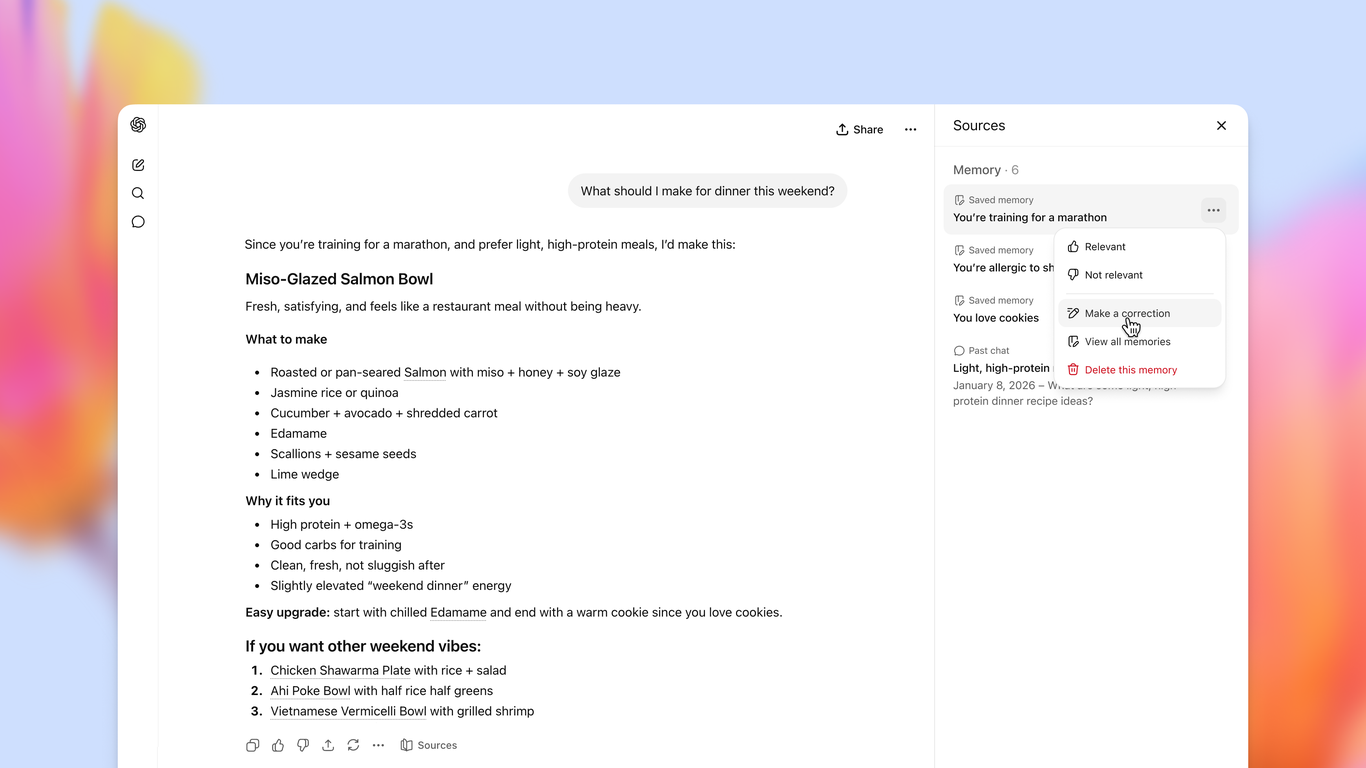
The new memory architecture is central. Instead of acting like a goldfish between sessions, GPT‑5.5 Instant will increasingly “draw on more of a user's context in responses to prompts. That includes information from past chats, files users have uploaded and Gmail, if connected,” Axios reports. The goal, according to OpenAI, is that “users won't have to repeat themselves as often.”
OpenAI is at least nodding to transparency. TechCrunch notes that “ChatGPT will also show memory sources across all models to help you understand where it generated the answers from.” Users can “delete outdated sources or correct them if the answer was wrong,” and crucially, “if you share a chat with someone, they won’t be able to see the memory sources.”
Axios adds that this “memory sources” control lets users see “some of the context ChatGPT used to personalize an answer, such as saved memories or past chats,” and that OpenAI says people “can delete or correct outdated memory and use temporary chats that do not use or update memory.”
Still, Axios underlines the uneasy trade: “Connecting your chatbot to third-party services means putting more of your personal or work information at risk. The tradeoff between efficiency and privacy online has been a constant battle ever since there was an internet.”
Tone, Style, and the UX of Trust
GPT‑5.5 Instant isn’t just different under the hood; it’s meant to sound different, too.
The updated default “respond[s] with more accuracy, more personalization and fewer gratuitous emoji,” Axios reports, echoing OpenAI’s line that it wants clearer, less cluttered replies. For “casual advice prompts,” the new Instant model is supposed to “avoid unnecessary follow-up questions and formatting that made responses feel cluttered.”
That tracks with the X thread Altman amplified on launch day, which called 5.5 Instant “a substantial improvement in intelligence, image perception, and factuality” and said it “updates the writing style to be a bit plainer and more straightforward.”
In other words, OpenAI is deliberately tuning the personality of its default assistant — dialing down cutesy flourishes and verbosity in favor of a more minimalist, “professional” tone. Altman’s own praise of “speed, intelligence, personality, and great memory/personalization” signals that OpenAI sees personality and memory as features of the same trust‑building layer, not cosmetic add‑ons.
But the company has learned that messing with personality is risky. TechCrunch reminds readers that OpenAI “withdrew its GPT-4o model” earlier this year and faced “significant backlash from users who related to the model’s ‘personality.’” Those users described GPT‑4o as their “best friend” or “a mirror,” and some even signed petitions to stop its retirement. Despite the outcry, GPT‑4o was deprecated in February 2026.
That history looms over GPT‑5.5 Instant’s rollout. A more subdued writing style and heavier personalization might make the assistant feel more competent — or more invasive, depending on your tolerance for AI intimacy.
What Changes for Users and Developers Now
From a practical standpoint, the switch is already underway.
TechCrunch reports that GPT‑5.5 Instant “will replace GPT-5.3 Instant as the default ChatGPT model,” and that for developers it “will be available through API as ‘chat-latest,’ with 5.3 available as an option for paid users for only three months.” Axios echoes that “GPT-5.5 Instant is rolling out to all ChatGPT users and to the API,” while paid ChatGPT users “can keep GPT-5.3 Instant for three months.”
For everyday users, the near‑term picture is simple: expect snappier responses that feel more on‑topic, fewer obvious blunders in high‑stakes domains, and an assistant that remembers more about you than it used to. For organizations, the new high‑capability classification in cybersecurity and bio‑risk, outlined in OpenAI’s system card, signals that OpenAI itself believes GPT‑5.5 Instant is powerful enough to warrant a fresh layer of safeguards.
The deeper question is whether a “switched on” chatbot that hallucinates less but remembers more is a net gain for users. On paper, GPT‑5.5 Instant promises a smarter, clearer, more personal web of assistance. In practice, the balance between convenience, dependence, and privacy is only getting harder to ignore.