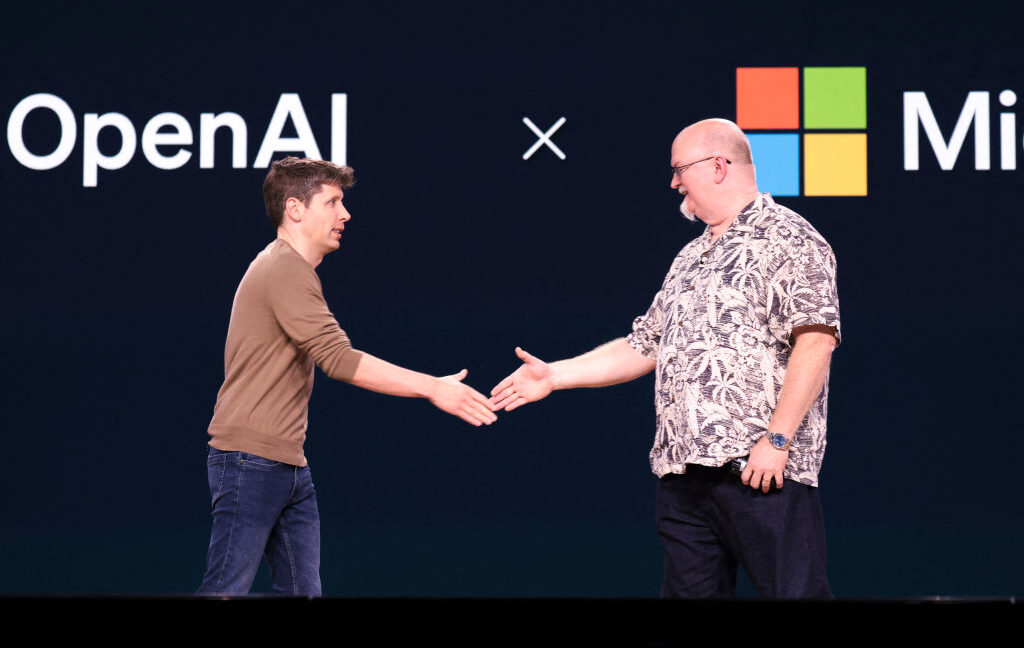
Microsoft and OpenAI have amended their long‑running partnership again, with both AI and Human coverage agreeing on a core set of facts. Microsoft remains OpenAI’s primary cloud partner with first‑ship rights on Azure for new models unless otherwise specified, while OpenAI is now free to serve its products across any cloud provider, including rivals like Amazon Web Services. Both sides report that Microsoft keeps a non‑exclusive license to OpenAI’s models and intellectual property through 2032, and that the new deal ends Microsoft’s obligation to share revenue with OpenAI, replacing it with a structure where OpenAI continues paying Microsoft for cloud and related services under a capped arrangement that runs to around 2030. Coverage also converges on the point that this is at least the second major renegotiation in roughly six months, following intense commercial and regulatory scrutiny of the pair’s relationship.
Outlets aligned in both groups also agree on key contextual elements that frame the renegotiation. They describe the shift as part of a broader move away from exclusivity, with OpenAI seeking operational flexibility to run its models where customers want them and to accommodate large third‑party deals, such as with Amazon, without breaching earlier constraints. Both AI and Human reporting note that Microsoft remains a major investor and strategic partner despite the loosening of exclusivity, and that the updated terms decouple financial and governance triggers from speculative milestones like artificial general intelligence. There is shared recognition that enterprises increasingly adopt multi‑cloud and multi‑model AI strategies, and that the revised agreement is meant to align the Microsoft–OpenAI relationship with this more pluralistic, interoperable market reality.
Areas of disagreement
Strategic framing of the deal. AI coverage tends to frame the renegotiation as a mutual optimization that enhances “flexibility, certainty, and broad AI benefit delivery” for both companies. Human coverage more often casts it as OpenAI formally ending an exclusive era, emphasizing that this is the second renegotiation in six months and interpreting it as a structural reset of the famed AGI‑linked pact. AI sources underplay any sense of rupture, whereas Human outlets highlight how the removal of AGI‑contingent clauses marks the symbolic end of a uniquely tight, high‑stakes alliance.
Power balance and leverage. AI sources typically portray Microsoft and OpenAI as remaining tightly aligned, stressing that Microsoft is still the primary cloud partner and major shareholder while OpenAI simply gains added deployment freedom. Human reporting is more attuned to shifts in leverage, underscoring that OpenAI can now run on competing clouds and that Microsoft’s license is explicitly non‑exclusive, potentially opening the door for rivals to access similar capabilities. Where AI coverage stresses continuity of partnership, Human coverage reads the same provisions as redistributing bargaining power and mitigating OpenAI’s dependence on a single tech giant.
Financial and commercial implications. AI coverage presents the revised financial terms in relatively neutral language, noting that Microsoft no longer pays a revenue share while OpenAI’s payments to Microsoft persist under a cap, and framing this as a cleaner, more predictable arrangement. Human outlets foreground the commercial stakes more aggressively, quoting Satya Nadella on being ready to “exploit” royalty‑free IP access to 2032 and highlighting Microsoft’s $37 billion AI run rate and OpenAI’s large‑customer status. AI narratives emphasize long‑term alignment and capped exposure, while Human reports stress how the royalty‑free license and capped payments could boost Microsoft’s margins and free OpenAI to chase large external deals without triggering costly AGI‑linked obligations.
Regulatory and competitive risk. AI coverage largely treats the new agreement as a way to enhance flexibility and interoperability, with only implicit nods to antitrust or legal concerns. Human coverage is more explicit that the renegotiation helps defuse potential legal peril around OpenAI’s multibillion‑dollar Amazon deal and reduces regulators’ worries about an overly exclusive tie‑up between two dominant AI players. AI sources focus on the partnership’s ability to support a broad ecosystem of AI users, whereas Human outlets frame the changes as pre‑emptive moves to manage regulatory scrutiny and competitive tensions in a rapidly consolidating AI market.
In summary, AI coverage tends to depict the renegotiated deal as a largely harmonious, technical evolution that preserves a strong partnership while broadening flexibility, while Human coverage tends to emphasize power shifts, commercial exploitation, and the unwinding of an unusually intense, AGI‑centric alliance under competitive and regulatory pressure.