AI
New ways to buy ChatGPT ads
We’re expanding ChatGPT ads with new ways for advertisers to buy and manage campaigns—built around our ads principles.
4 days ago
OpenAI is officially turning ChatGPT into an ad business — and doing it while insisting the chatbot’s answers won’t be for sale. The company is racing to build a new kind of advertising platform before public trust, and regulators, decide what “AI ads” should even mean.
In early May 2026, OpenAI shifted its ads experiment in ChatGPT from a quiet pilot into an emerging product line.
On May 5, the company outlined “new ways to buy ChatGPT ads,” announcing that advertisers could now run campaigns through major agency and tech partners, and — crucially — via a new beta self-serve Ads Manager for U.S. businesses. The pitch was simple: bring familiar digital ad tools into an unfamiliar environment — conversational AI — without importing the worst of the surveillance web.
OpenAI framed the move as an expansion of a pilot it had already been running with a small group of advertisers, describing this next step as making it “easier for businesses to participate while keeping the experience useful, private, and clearly separate from ChatGPT’s answers.”
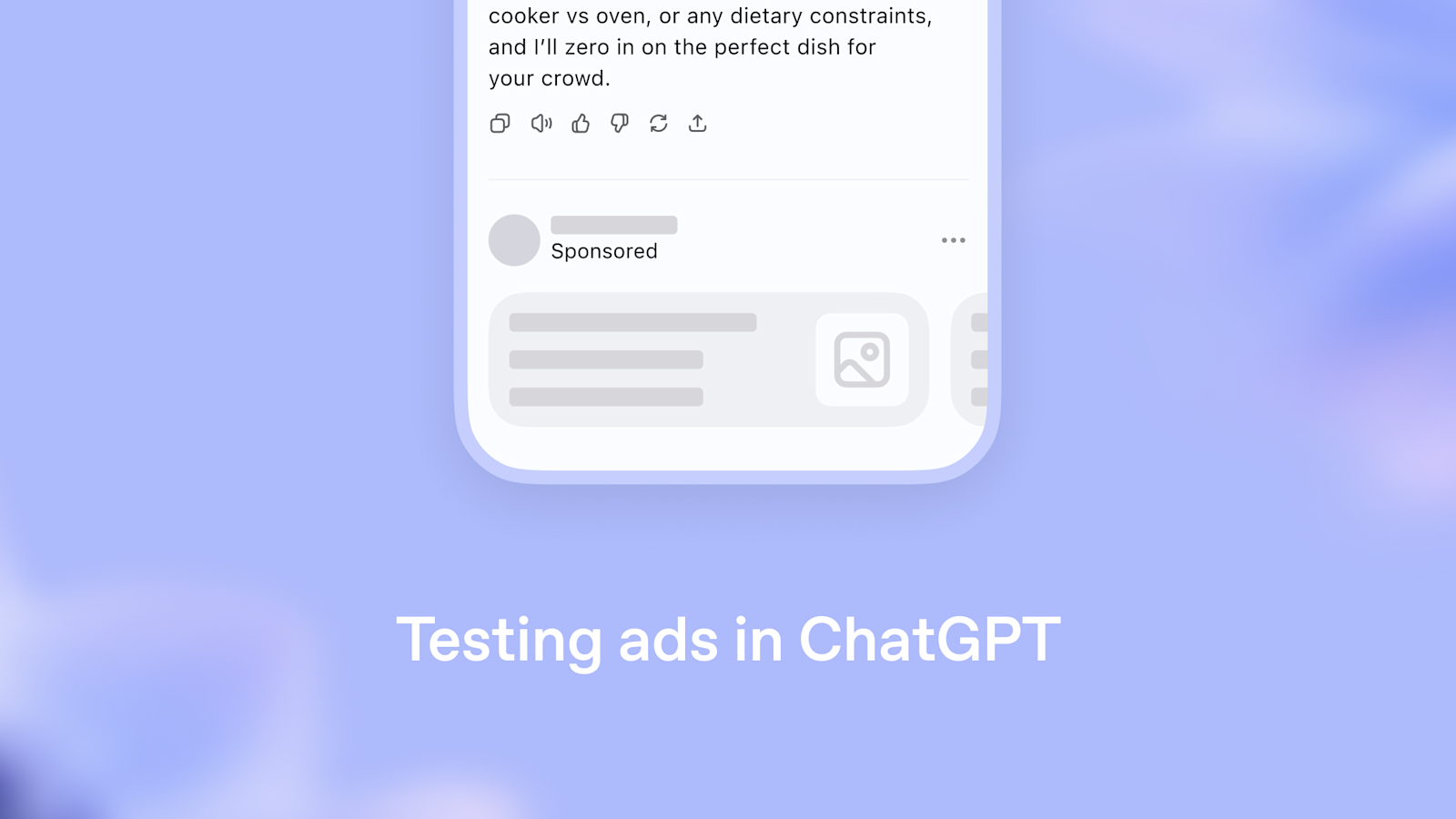
Two days later, on May 7, OpenAI dropped the other shoe: ads were now being tested directly in ChatGPT for real users in the U.S. The company described the move bluntly in a blog post titled “Testing Ads in ChatGPT,” summarizing the strategy as: “Ads that support free access and don’t change ChatGPT answers.”
In other words, the ad engine and the answer engine are supposed to live side by side — but not cross wires.
OpenAI is trying to build something that looks familiar enough to marketers to unlock budgets, but different enough to reassure users who’ve come to ChatGPT for help, not hype.
The May 5 announcement sketches a classic ad-tech story: first, work directly with a small group of advertisers; then broaden via intermediaries; then open the gates to self-serve.
OpenAI says it has been “collaborating with leading agency partners including Dentsu, Omnicom, Publicis, and WPP to support businesses purchasing ChatGPT ads,” and has added tech partners such as “Adobe, Criteo, Kargo, Pacvue, and StackAdapt.” For now, those partners help with planning and creative while “OpenAI’s ads system controls all delivery decisions.”
The real pivot is the self-serve Ads Manager, now rolling out in beta to U.S. advertisers. Through this portal, businesses can “register as advertisers, add payment information, set budgets, bids and pacing, upload ads, launch and manage campaigns, and view performance in the portal.”
OpenAI is also introducing cost-per-click (CPC) bidding and “expanded measurement tools,” promising that brands can “buy, manage, and understand campaign performance without sharing conversations or personal details with advertisers.”
In other words: it’s an auction-based performance ad system — but with a hard privacy line drawn around user chats.
The May 7 post draws the boundary between the chat product people know and the ad layer now being bolted on top.
OpenAI says the initial test is limited to “logged-in adult users on the Free and Go subscription tiers.” Higher-paying tiers — “Plus, Pro, Business, Enterprise, and Education” — are explicitly carved out and “will not have ads.”
The company insists that “ads do not influence the answers ChatGPT gives you, and we keep your conversations with ChatGPT private from advertisers.” Instead, ads are meant to sit alongside or near answers, labeled and separated, while targeting and reporting lean on aggregate signals rather than raw conversation logs.
The rationale is unapologetically economic: “Our goal is for ads to support broader access to more powerful ChatGPT features while maintaining the trust people place in ChatGPT for important and personal tasks.”
OpenAI frames this as a test phase — “We’re starting with a test to learn, listen, and make sure we get the experience right” — but the direction of travel is clear. The company is already planning to expand beyond the U.S., first to Canada, Australia, and New Zealand, then “in the coming weeks” to the United Kingdom, Mexico, Brazil, Japan, and South Korea, with hopes of reaching “many more markets this year.”
From OpenAI’s perspective, this is a necessary evolution to keep ChatGPT widely accessible while containing the creep factor.
The company stresses that its “ads pilot is focused on supporting broader access to ChatGPT while preserving consumer trust, usefulness, and user control.” Early signals, it claims, are positive: “no impact on consumer trust metrics, low dismissal rates of ads, and ongoing improvements in the relevance of ads as we learn from feedback.”
Those metrics matter because the entire experiment hinges on a promise: you can fund the model with ads without turning the model into an ad.
“As we expand our pilot,” OpenAI writes, “our core principles remain the same: ChatGPT’s answers remain independent and unbiased, conversations stay private, and people keep meaningful control over their experience.”
The May 5 post echoes that line at the product level, describing the expanding ad tools as “built around our ads principles” and “clearly separate from ChatGPT’s answers.”
OpenAI also says the platform is being designed to “help users discover relevant products and services through ads, while ensuring ChatGPT’s answers remain independent and conversations private.”
It’s a tightrope: the more “relevant” ads become to what you’re doing in ChatGPT, the more users will question how insulated their conversations really are from the targeting logic.
For agencies and brands, ChatGPT ads are less a novelty than a new surface in a familiar game.
OpenAI’s partner list — spanning legacy holding companies like WPP and Publicis and digital players like Criteo and StackAdapt — signals that the company is plugging into existing ad-buying workflows, not asking media buyers to reinvent the wheel.
The promise to advertisers is reach plus intent. ChatGPT sits at the center of millions of high-intent queries — from coding fixes and travel planning to financial guidance and health questions — but OpenAI is adamant that advertisers will only see “aggregated performance data,” not individual conversations.
The Ads Manager is pitched as accessible to “companies of all sizes, from SMBs and startups to global brands, to grow their businesses via ChatGPT.” With CPC bidding and budget controls, this starts to look like a search-style performance channel layered into AI chat.
If OpenAI can deliver measurable outcomes without the invasive tracking that defined the last generation of ad tech, it could set a precedent for how monetization works in generative AI. If not, it risks importing all the old problems into a more intimate medium.
For users, the trade-off is blunt: keep ChatGPT free and increasingly capable, but accept that the interface will be commercialized — unless you pay to make the ads go away.
OpenAI underscores that “Plus, Pro, Business, Enterprise, and Education tiers will not have ads,” reasserting a two-tier internet: ad-supported for the masses, ad-free for those who can afford subscriptions or corporate licenses.
The company insists that “people keep meaningful control over their experience,” signaling that users will have at least some ability to manage or mute ad exposure, and reiterates that “conversations stay private” and are not shared with advertisers.
Still, the very act of placing paid messages beside AI-generated guidance on “important and personal tasks” invites scrutiny. How aggressively can OpenAI personalize ad relevance without breaching the spirit of its own promises?
Chronologically, OpenAI’s move looks less like an experiment and more like a phased rollout of a core revenue pillar:
At each step, OpenAI repeats three mantras: ads will not change ChatGPT’s answers; conversations will remain private; and users will retain control.
Whether that’s enough to keep regulators, privacy advocates, and everyday users on side will depend less on the blog posts and more on the lived experience: which questions trigger ads, how aggressively they’re targeted, how easy they are to dismiss — and whether an AI assistant that helps you plan your life can really stay neutral when there’s now a line item on the balance sheet called “Ads.”